


What Materials Can a Wire and Cable Extrusion Machine Process?
 Oct 20, 2026|
 View:7
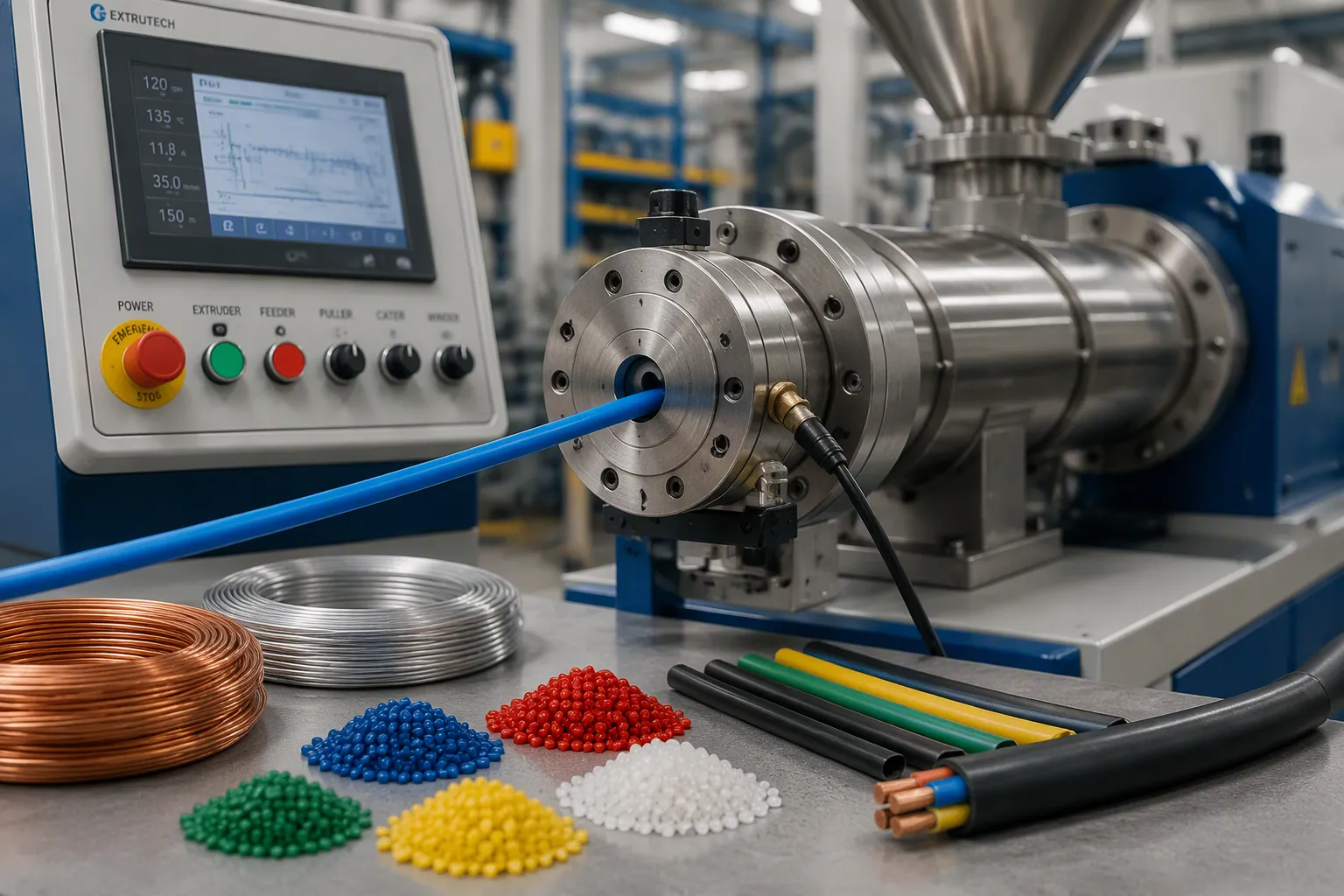
A wire and cable extrusion machine works with thermoplastic or thermosetting polymers. These include PVC, PE, XLPE, PP, PU, PA, CPE, and special fluoropolymers like FEP and PFA. These raw materials, usually polymers, soften or cure into a continuous layer of insulation or sheath around a copper or aluminum conductor. Material choice depends on temperature rating, flexibility, and compliance needs. Common materials, including PVC, PE, silicone, and XLPE, each do a different job. Thermoplastics and thermosetting polymers act differently during cable extrusion, so processors must match materials to the application. Silicone and other polymers widen the range of materials that can be used in the cable extrusion process. This cable insulation choice shapes performance.
Key Takeaways
Wire and cable extrusion machines can work with many kinds of plastic. These include PVC, PE, XLPE, and special materials like FEP.
Each material has special qualities that fit certain cable uses, such as resistance to fire or the ability to handle high heat.
Setting up the machine correctly and drying the material well are key for steady extrusion and top-quality cable insulation.
Following rules like UL and CSA keeps specialty cables safe and helps them sell in the market.
Picking the right material means weighing performance, cost, and rules to get the best result.
Thermoplastic Materials for Cable Extrusion
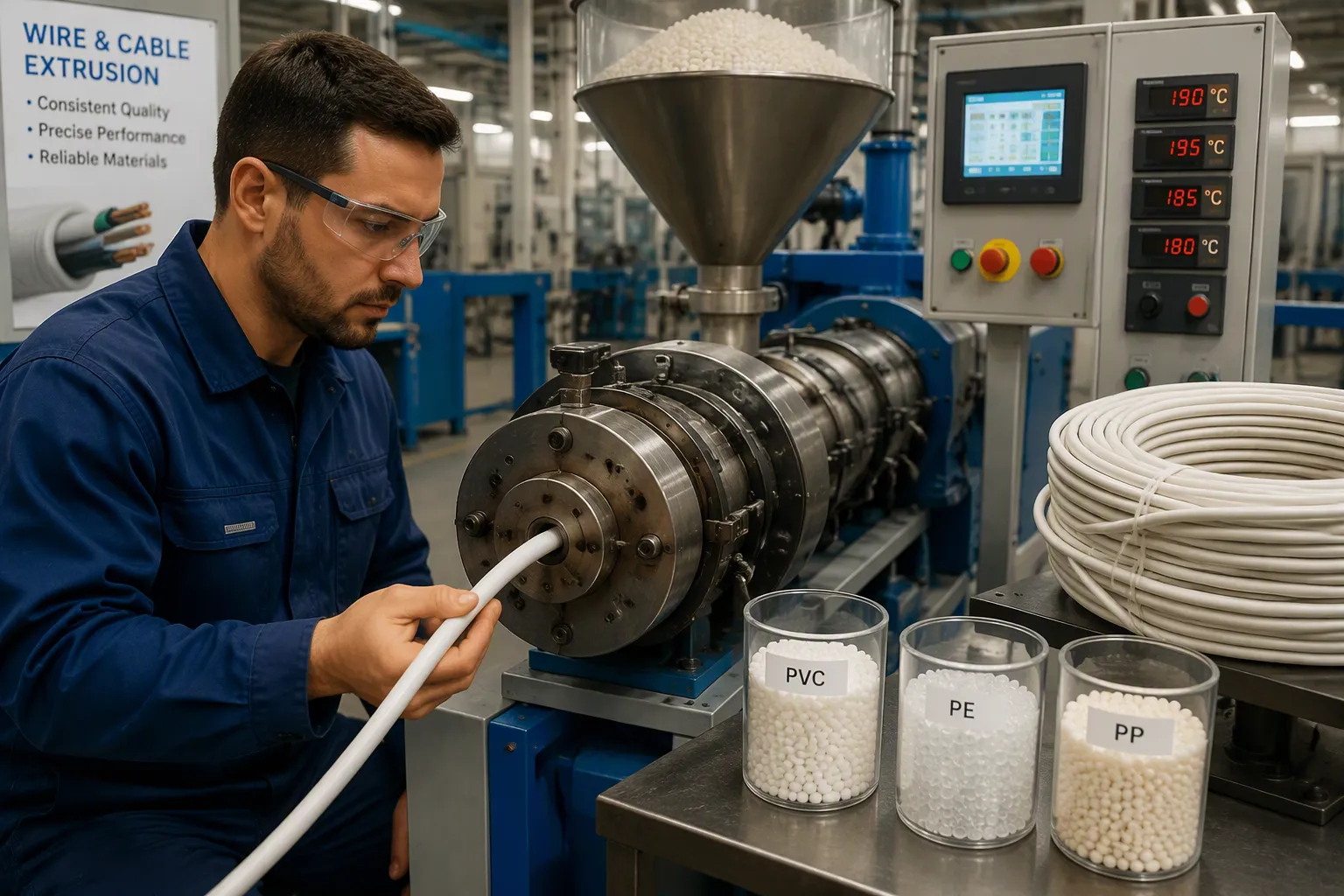
Thermoplastics make up the biggest group of materials that a wire and cable extrusion machine can process. These polymers get soft when heated and turn hard again as they cool. That means the extruder can shape them into a steady insulation or jacket layer without a chemical curing step. PVC, PE, PP, and CPE are the main types in this group. Each one offers a different mix of flexibility, dielectric strength, flame resistance, and cost.
PVC, PE, and PP Properties
Polyvinyl chloride, or PVC, gives strong flame resistance and good mechanical toughness at a low cost. Makers add plasticizers to adjust how flexible it is, so PVC covers a wide range of hardness. It works well for building wire, control cables, and general-purpose jacketing. PE, or polyethylene, provides high dielectric strength and takes in very little moisture. It is a good fit for data cables, coaxial cables, and low-voltage insulation. PP, or polypropylene, offers good heat resistance and stiffness at a moderate cost. It is used in automotive wire and thin-wall insulation. CPE, a chlorinated polyethylene, combines flexibility and flame retardance, and it often shows up in flexible cords and industrial cable jackets.
Applications and Processing Notes
Each thermoplastic needs its own processing window. PVC is amorphous and sensitive to heat, so it needs careful temperature control to stop localized thermal degradation. PE and PP are semi-crystalline and need enough shear and heat to melt fully. Screw design matters as much as barrel temperature. The table below sums up the recommended compression ratios and feed-zone guidance for these materials.
Polymer | Recommended Compression Ratio (Screw Configuration) | Feed-Zone Temperature Guidance |
|---|---|---|
PE (semi-crystalline) | Higher ratio, 3–4, to ensure complete melting | Keep feed zone 30–50 °C below melting point; avoid premature melting at feed throat |
PP (semi-crystalline) | Higher ratio, 3–4, to ensure complete melting | Keep feed zone 30–50 °C below melting point; avoid premature melting at feed throat |
PVC (amorphous/heat-sensitive) | Lower ratio, 1.6–2.5, to prevent localized thermal degradation | Not specified in source |
Across polymers, a general compression ratio range falls between 2.5 and 4. For semi-crystalline materials, the feed zone stays well below the melting point. This keeps the raw materials, in pellet form, from sticking at the feed throat. Cooling also shapes the final result. Water-bath cooling after the crosshead sets the insulation dimensions and surface finish. PVC needs gentler cooling to avoid internal stress, while PE and PP can handle faster quench rates. Operators should match screw geometry, temperature profile, and cooling length to the specific compound. This approach keeps cable extrusion stable and protects the insulation quality.
Cross-Linked and Engineering Materials
XLPE, PU, and PA Performance
Cross-linked polyethylene, or XLPE, begins as polyethylene and forms a chemical bond network between its polymer chains. This network raises the heat rating and dielectric performance far above standard PE. XLPE works well in medium- and high-voltage power cable insulation and in automotive and appliance wire. A well-set-up wire and cable extrusion machine can process crosslinkable insulation compounds without any trouble.
Polyurethane, or PU/PUR, offers excellent abrasion resistance and flexibility. It works well for robotic cable, mining cable, and other jacketing jobs that face constant flexing and surface wear. Nylon, or PA, adds strong mechanical and chemical resistance. Thin nylon layers often go over softer insulation in automotive and industrial cable designs.
Extrusion Processing Considerations
Moisture control is very important for XLPE. Silane-grafted compounds cure through hydrolysis and condensation, and a water bath or ambient humidity starts that reaction. Peroxide systems need scorch protection, and quinone-based inhibitors raise the safe processing temperature by 15–25°C. The table below sums up the main cross-linking routes and their key conditions.
Category | Method / Mechanism | Key Parameters & Conditions |
|---|---|---|
Moisture cross-linking (silane grafting) | Alkoxysilane groups grafted onto PE backbone via reactive extrusion with peroxide catalyst | Peroxide (DCP) 0.05–0.2 phr; twin-screw 160–200°C; residence 30–90 s; grafting 1–3 wt.% silane |
Moisture curing kinetics | Alkoxysilane hydrolysis to silanols, then condensation to siloxane crosslinks | 60–90°C water bath or ambient humidity 7–14 days; DBTDL catalyst 0.01–0.1 phr |
Peroxide cross-linking | DCP / di-tert-butyl peroxide; promoters TAIC/TAC | 0.1–5 phr; half-life >3 min at 190°C; gel content 80–90% |
Die design also shapes the result. PU and PA need balanced flow channels to avoid melt fracture at high line speeds. Operators should match screw geometry, temperature profile, and curing method to each compound. This care keeps cable extrusion stable across all three materials.
Specialty and High-Performance Materials
FEP, PFA, and Rubber-Based Compounds
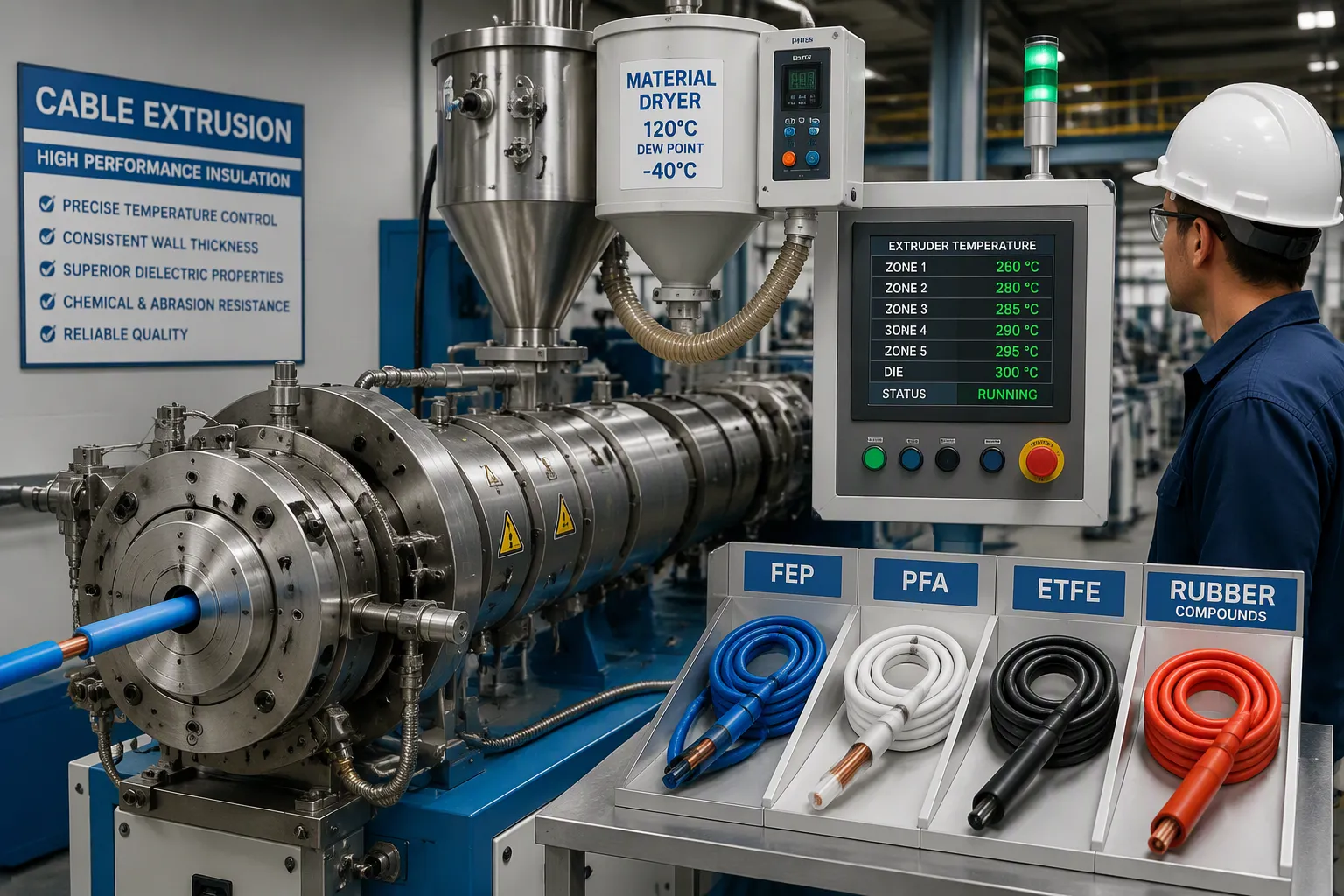
Fluoropolymers are used for the toughest cable jobs. FEP, PFA, and ETFE each give high heat tolerance, chemical resistance, and strong electrical performance. FEP works continuously near 200°C and offers excellent chemical resistance, low friction, and excellent insulation. PFA goes further, with a top continuous service temperature near 260°C and higher resistance to acids, alkalis, and solvents. ETFE has a melting point up to 270°C and gives excellent weathering and UV resistance, but its continuous temperature range is lower and its chemical resistance is more limited. The table below compares the three.
Material | Temperature Range | Chemical Resistance |
|---|---|---|
FEP | -200°C ~ 205°C (up to ~200°C continuous) | Excellent |
PFA | -200°C ~ 260°C | Excellent |
ETFE | -200°C ~ 150°C (melting point up to 270°C) | Good (limited chemical resistance) |
Rubber-based compounds and thermosetting systems round out this group. Silicone stays flexible across a wide temperature span and suits heat-exposed appliance and industrial cable. These materials cure instead of re-melting, so they hold their shape under heat. They fit aerospace, oil and gas, medical, and high-temperature sensor cable, where standard thermoplastics fall short.
Specialty polymers need special extrusion setups. Fluoropolymers melt at high temperatures and release corrosive byproducts, so barrels, screws, and tooling need corrosion-resistant alloys. Rubber-based compounds often run on cold-feed or hot-feed systems with different screw geometry. HANDING (Handing) supplies wire and cable extrusion lines plus auxiliary equipment such as crossheads, hoppers and dryers built for these specialty materials. Proper drying matters, because moisture in hygroscopic compounds causes voids and surface defects in the finished insulation.
Compliance and Processing Requirements
Specialty cable must meet named standards before it reaches the market. Flame and smoke behavior follows UL 1685 or UL 2556 for limited-smoke wiring materials, which cover vertical-tray fire propagation and smoke release. Low-smoke halogen-free jackets are evaluated under UL 2885 and IEC 61034-2 for acid gas, acidity, conductivity, and halogen content. Restricted substances fall under UL 746R for nonmetallic components and UL 1368 for metallic parts. The AG14 marking caps acid gas at no more than 14% by weight, calculated as HCl.
Processing control supports compliance. Operators must hold melt temperature inside a narrow window, because fluoropolymers degrade quickly above their rated range. Crosshead die design shapes concentricity and surface finish at high line speeds. Dryers remove moisture before the feed throat, and filtered melt flow keeps contamination out of thin insulation walls. A well-matched machine, tooling set, and drying routine let manufacturers run these materials with stable cable extrusion and consistent test results.
Material Comparison Guide
Performance, Fit, and Compliance
Each material family has its own job. PVC gives flame resistance and toughness at low cost. PE and PP offer strong dielectric strength for data and power cable. XLPE raises the heat rating for medium- and high-voltage insulation. PU and PA add abrasion and chemical resistance for demanding jackets. Fluoropolymers and silicone handle extreme heat and harsh chemicals. No single option wins everywhere; the right choice depends on the application.
Compliance shapes the selection as much as performance. UL certification proves safety for the US market, and CSA certification governs Canada, with the CSA US mark providing dual clearance. UL 1581 sets conductor dimensions, insulation thickness, and jacket compounds for general wire, while UL 758 governs appliance wiring material. Aerospace and defense programs add AS9100 quality management and the NAVAIR Qualified Products List, which requires rigorous testing before a supplier qualifies. Third-party marks carry far more commercial weight than self-declaration.
Cost and Comparison Table
Cost follows performance. PVC and PE sit at the low end, PP and CPE in the middle, and XLPE, PU, and PA climb higher. Fluoropolymers and silicone cost the most, reflecting their processing demands and raw material prices. The table below compares the main options.
Material | Performance | Application Fit | Compliance | Cost |
|---|---|---|---|---|
PVC | Flame resistant, tough, flexible | Building wire, control cable | UL 1581, UL 758 | Low |
PE / PP | High dielectric strength, low moisture uptake | Data, coaxial, automotive | UL 1581 | Low to moderate |
CPE | Flexible, flame retardant | Flexible cords, industrial jackets | UL 1581 | Moderate |
XLPE | High heat rating, strong dielectric | Power cable insulation | UL 1581 | Moderate to high |
PU / PA | Abrasion and chemical resistance | Robotic, mining, automotive | UL 758 | High |
FEP / PFA / ETFE | Extreme heat and chemical resistance | Aerospace, oil and gas | AS9100, NAVAIR QPL | Highest |
HANDING (Handing) builds extrusion lines and auxiliary equipment tailored to this full range of materials. Matching machine configuration to the chosen compound keeps extrusion stable and test results consistent.
A wire and cable extrusion machine works with many kinds of materials. Thermoplastics like PVC, PE, PP, and CPE are used for building wire, data cable, and flexible cords. Cross-linked and engineering polymers such as XLPE, PU, and PA fit power insulation, robotic cable, and rough environments. Specialty materials like FEP, PFA, ETFE, and rubber-based compounds cover aerospace, oil and gas, and high-heat jobs.
When choosing a material, balance performance, compliance, and cost. A well-set-up extrusion line can run this full range with steady output. Readers can ask HANDING or their technical team about specific material and machine setup needs.
FAQ
Which materials can a wire and cable extrusion machine process?
One line can run thermoplastics like PVC, PE, PP, and CPE. It can also run cross-linked and engineering grades like XLPE, PU, and PA. Specialty options such as FEP, PFA, ETFE, and silicone are possible too. The compound you pick depends on the temperature rating, flexibility, and compliance needs of the finished cable.
How does a processor choose between PVC and PE?
PVC offers flame resistance and toughness at low cost, so it suits building wire and general jacketing. PE delivers high dielectric strength and low moisture uptake, which fits data and coaxial cable. The application decides the fit, and neither option wins everywhere.
What makes XLPE different from standard PE?
XLPE forms a chemical bond network between its polymer chains. That network raises the heat rating and dielectric performance well above standard PE. Moisture control and the right cross-linking method matter during extrusion. Silane systems cure through hydrolysis, and peroxide systems need scorch protection.
Why do fluoropolymers need special extrusion setups?
FEP, PFA, and ETFE melt at high temperatures and release corrosive byproducts. Barrels, screws, and tooling therefore need corrosion-resistant alloys. PFA runs continuously near 260°C, so operators must hold melt temperature inside a narrow window. This protects the insulation and keeps test results consistent.
Which standards apply to specialty cable insulation?
Flame and smoke behavior follows UL 1685 or UL 2556. Low-smoke halogen-free jackets are evaluated under UL 2885 and IEC 61034-2. Aerospace programs add AS9100 and the NAVAIR Qualified Products List. General wire falls under UL 1581, and appliance wiring material falls under UL 758.