


PVC vs. PE Cable Extrusion: How to Choose the Right Process
 Oct 21, 2026|
 View:6
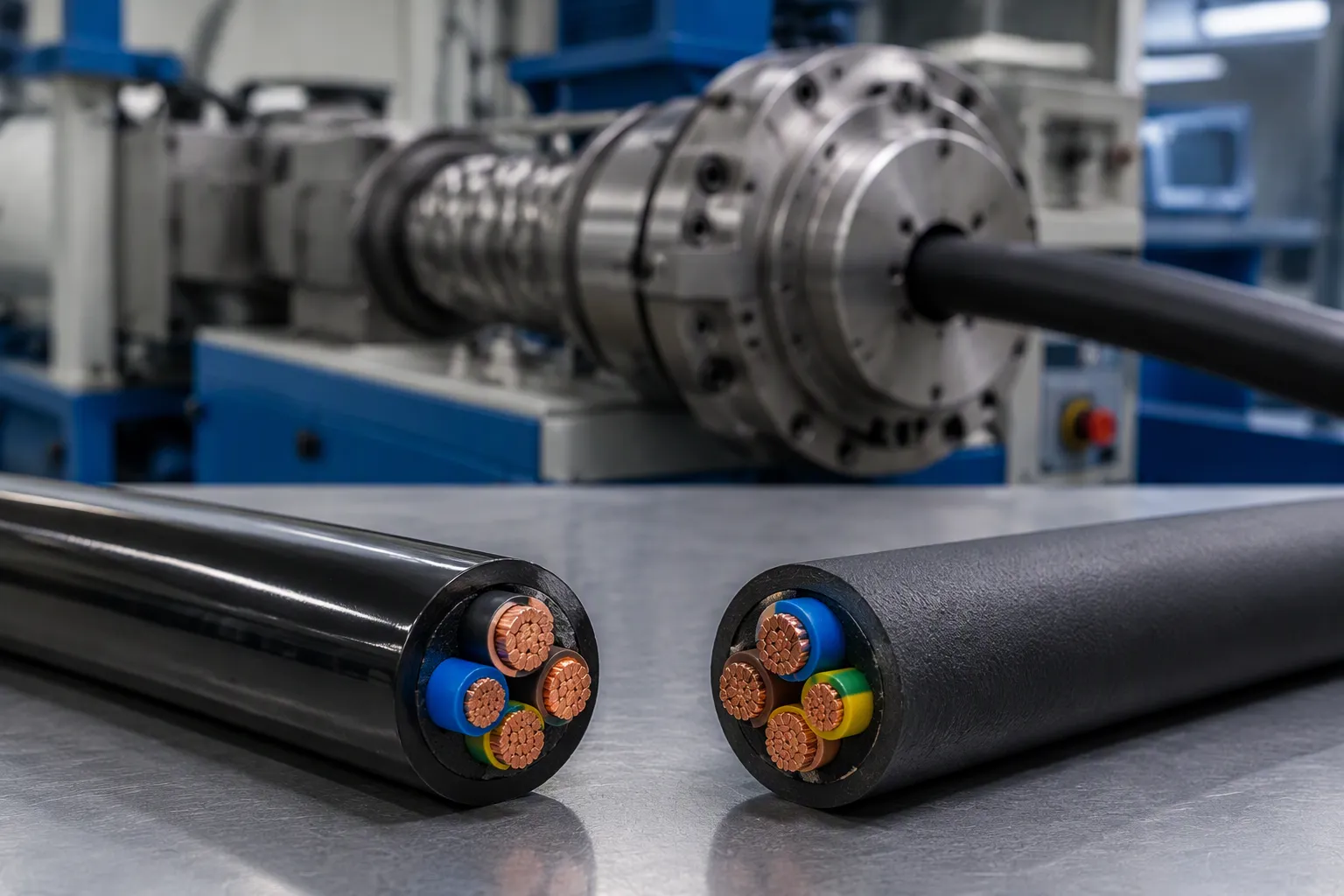
PVC and PE require different extrusion processes. PVC cable extrusion typically runs on a twin-screw extruder with dry blend, while a PE extrusion machine runs on a single-screw extruder with pellets. Material properties drive this split. The choice determines the extruder type, the material form, and every process setting that follows.
This decision matters before any quote. Start with the service environment, then stiffness, then conductor size, insulation thickness, and target output. Single-screw extruders work well with pelletized PE. Twin-screw extruders handle PVC dry blend. Each machine fits its material. Neither setup wins overall. The right extruder depends on the cable and the job.
Key Takeaways
PVC needs a twin-screw extruder with dry blend. PE needs a single-screw extruder with pellets.
Choose PVC for low-cost, low-voltage indoor cables. Choose PE or XLPE for high heat, moisture, or high voltage.
Match conductor size to extruder size: 45 mm for small wires, 60–90 mm for medium, 120 mm+ for large cables.
Control temperature carefully: PVC runs cooler (around ±2°C), PE runs hotter.
Dry materials and center the die to prevent surface defects and voids.
PVC Cable Extrusion: Core Processing Differences
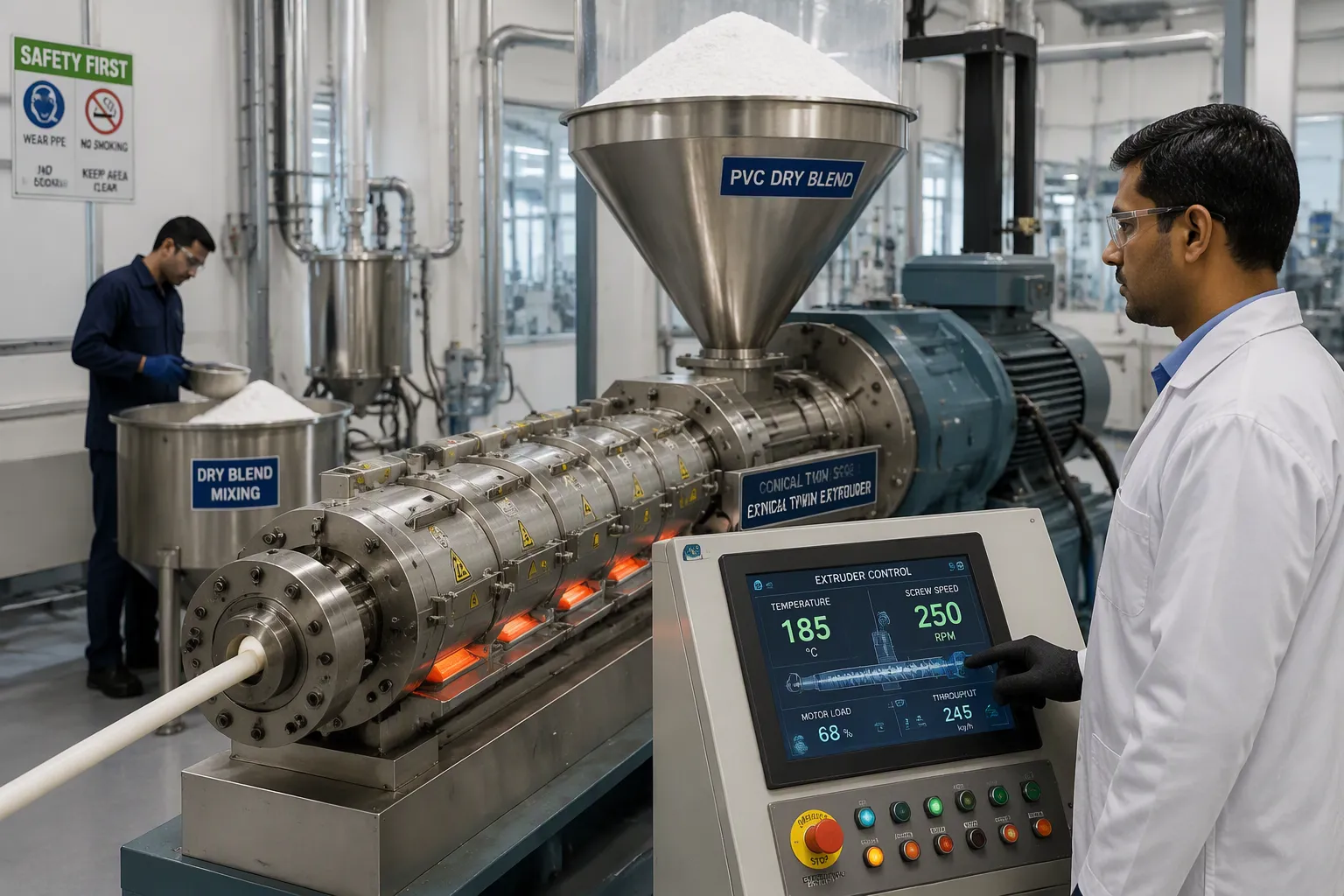
PVC and PE take different paths in the factory. Feed form, screw design, and heat control all differ. These processing differences shape equipment choice and every setting that comes after. Teams comparing PVC cable extrusion, PE extrusion machine options should start with the material form.
PVC Extrusion: Dry Blend and Twin-Screw
Rigid PVC comes as a dry blend of resin powder pre-mixed with stabilizers, lubricants, fillers, and other additives. Flexible compounds use ready-made pellets. PVC extrusion depends on a twin-screw extruder, especially a conical design, for strong mixing and even melting at lower screw speeds. This method avoids heat damage to the heat-sensitive polymer while spreading additives well.
A double-screw extruder brings clear benefits to this job. The table below sums up the main points.
Advantage | Conical Twin-Screw (dry blend) | Comparison / Note |
|---|---|---|
Feed handling | Large-diameter feed zone takes in loose dry blend without bridging | Feeding problems mostly eliminated |
Low-speed operation | Usually 20–45 rpm, which cuts frictional heat | Prevents degradation (the polymer degrades above ~200 °C) |
Energy efficiency (SEC) | 0.12–0.22 kWh/kg on rigid compound | vs. 0.18–0.35 kWh/kg for high-speed parallel twin-screw |
Melt temperature control | Variation within ±2–4 °C | vs. 5–10 °C for parallel twin-screw lines |
Self-wiping action | Intermeshing flights clear material from screw surfaces | Prevents localized overheating |
The key point is not maximum shear. PVC is heat-sensitive, so the process must promote full plasticization while preventing shear overheating, discoloration, charring, and decomposition.
Operators control the process in stages:
Twin-screw systems convey, mix, and plasticize the dry blend in a controlled way.
Barrel heat and mechanical energy soften and fuse the powder step by step.
Stable melt pressure, controlled residence time, and steady throughput prevent too much degradation.
Screw configuration matters as much as speed. Kneading blocks and mixing elements spread additives without hot spots. Venting ports release volatiles before the die. The dry blend must reach full fusion before the die. Incomplete fusion shows up as a rough surface and weak mechanical strength. Counter-rotating designs apply lower shear between flights. Modular barrels and screws allow precise temperature zoning and quick changes to new formulations. The processing difference between rigid and flexible grades lies mainly in feed form. These features suit PVC extrusions for cable coatings and PVC pipe extrusion processes alike. Modern pvc extruder machines include high-output extrusion lines and continuous extrusion machines. Double screw extruders also serve compounding duties. Each setup fits its material.
PE Extrusion Machine Setup and Material Form
PE runs as pellets on single screw extruders. A single-screw extruder relies on drag flow to move solid pellets, melt them, and pump the melt. Screw geometry differs from PVC designs. PE needs higher temperatures and different compression ratios. Single screw extruders handle pellet feed well. The PE extrusion machine pairs a grooved feed section with a barrier screw for stable output.
The single-screw route demands attention to feed throat design and screw cooling. Pellet quality affects melt consistency. Moisture control matters too. A dryer before the hopper protects against voids and surface defects. Output stability depends on consistent pellet size and a steady feed rate. Cooling trough length and water temperature set the final insulation dimensions. Line speed must match the cooling rate. Extrusion demands tight control of melt temperature and pressure. Modern options include high-output extrusion lines and continuous extrusion machines for both material families. Neither setup is superior. The single-screw route suits pelletized PE. The twin-screw route suits dry blend. Teams weighing PVC cable extrusion, PE extrusion machine configurations should match each route to its polymer. A well-matched extruder keeps processing stable and product quality consistent.
Process Parameters That Affect Quality
Temperature Control and Screw Configuration
Temperature settings depend on the plastic. PVC softens and runs at lower barrel temperatures, and its finished insulation works in a range of about 70–90°C. PE and XLPE can take much more heat and run hotter through the barrel and die. PVC also breaks down fast near 170°C and gives off HCl, so the screw and barrel must resist corrosion. On PVC lines, operators keep temperature control accuracy close to ±2°C.
Screw shape tells the same story. A PVC screw usually runs L/D 16–20 with a shallow metering depth of 0.07D and a compression ratio of 1.6–2. It is split into feed and compression zones of about 40% each. Low shear protects the melt from heat damage. A rigid PVC screw often skips the check ring and uses a head taper of 20°–30°. Cooling holes in the feed section help stop the material from melting too early.
Material | Typical compression ratio | Rationale |
|---|---|---|
Rigid PVC | ~2.0–2.5 (low) | Heat-sensitive; low shear avoids scorching and degradation |
PE / PP | ~3.0–4.0 (high) | Tolerant of shear; needs shear to fully melt |
Running PVC on a high-compression PE screw causes burning and discoloration. The opposite mismatch starves the PE melt.
Barrier screws separate melting from metering, so metering depth can be set for head pressure, melt temperature, and mixing independently of feed depth. Compression ratio therefore matters most on conventional screws.
Die Head, Cooling, and Line Speed
Die head design sets insulation concentricity and surface finish. A smooth flow path with balanced pressure works for both materials. PVC needs a corrosion-resistant head and gentle shear. PE can handle tighter draw-down ratios.
Cooling and line speed work as a team. Water temperature and trough length fix the final insulation dimensions. Line speed must match the cooling rate, or the insulation stays soft and deforms at the capstan. A dryer before the hopper protects PE from voids. Each machine setting follows the polymer, and stable processing keeps quality consistent across double screw extruders and single screw extruders alike. A single-screw line and a twin-screw extruder each reward tight parameter control.
Material Property Differences
Mechanical and Long-Term Performance
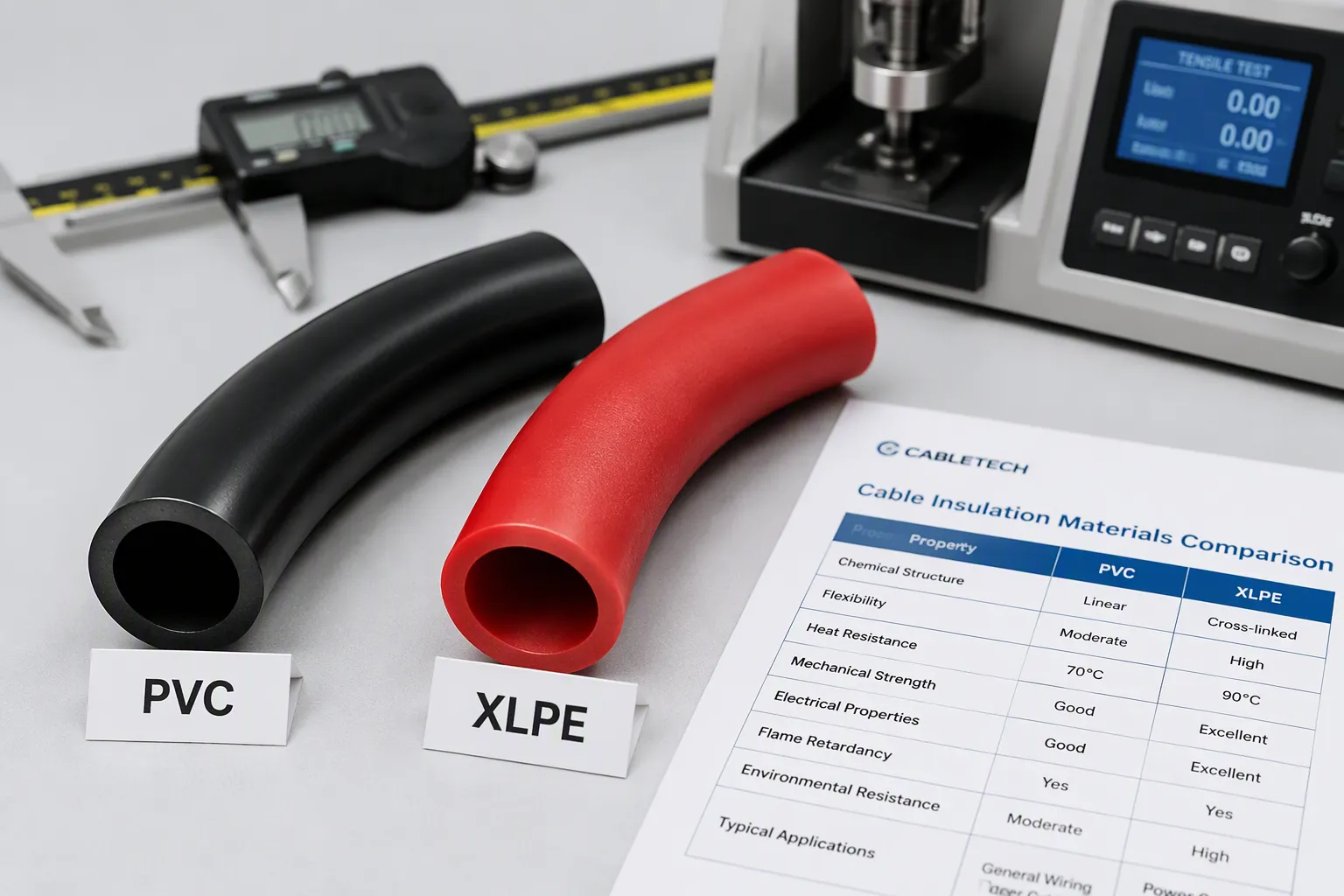
Strength and flexibility set the two compounds apart. PVC has a tensile strength of 15–25 MPa and stretches 100–250% before it breaks. Cross-linked PE (XLPE) reaches 20–25 MPa and stretches 150–300%. The source data covers cross-linked polyethylene, not plain PE, so readers should treat these as XLPE numbers.
Material | Tensile Strength (MPa) | Elongation at Break (%) |
|---|---|---|
PVC | 15–25 | 100–250 |
XLPE/XLPO | 20–25 | 150–300 |
Long-term behavior tells a different story. PVC plasticizer can slowly leak out, and the compound gets stiffer and more brittle as it ages. It still resists creep well under steady load at moderate temperature. XLPE cross-linking locks the molecular structure in place, so it resists creep and heat ageing much better. Moisture moves slowly through the insulation in both polymers, though PE grades usually let less through.
Water chemistry matters too. Biofilm grows most on HDPE, less on PEX, and least on PVC. Biofilm formation potential, measured by ATP and E. coli, runs higher for polyethylene than for PVC. PVC does release chlorinated and organotin compounds plus volatile aldehydes, and these can be more toxic to bacteria than what other pipe materials release. Each behavior fits a different service condition.
Technical Specifications Comparison
Electrical performance favors XLPE. PVC shows a dielectric constant of about 3.5–4.0, while XLPE sits near 2.3 at 1 MHz and 23°C.
PVC exhibits a dielectric constant of roughly 3.5–4.0, while XLPE is comparable at approximately 2.3 (at 1 MHz, 23°C).
Material
Continuous Temp Range
Peak/Surge Temp
Dielectric Constant (at 1 MHz)
Dissipation Factor
PVC
-10°C to +105°C
+120°C
3.5–4.5
0.01–0.02
XLPE
-40°C to +125°C
+150°C
2.3
0.0003–0.0005
Cost splits the same way. PVC is the cheapest insulation option. XLPE costs about 20–40% more than PVC, and insulation usually makes up 15–30% of wire cost. A ten-year comparison shows PVC at $5,000 initial cost against $7,000 for XLPE, yet replacements, labor, and downtime push the PVC total to $69,000 versus $15,000 for XLPE.
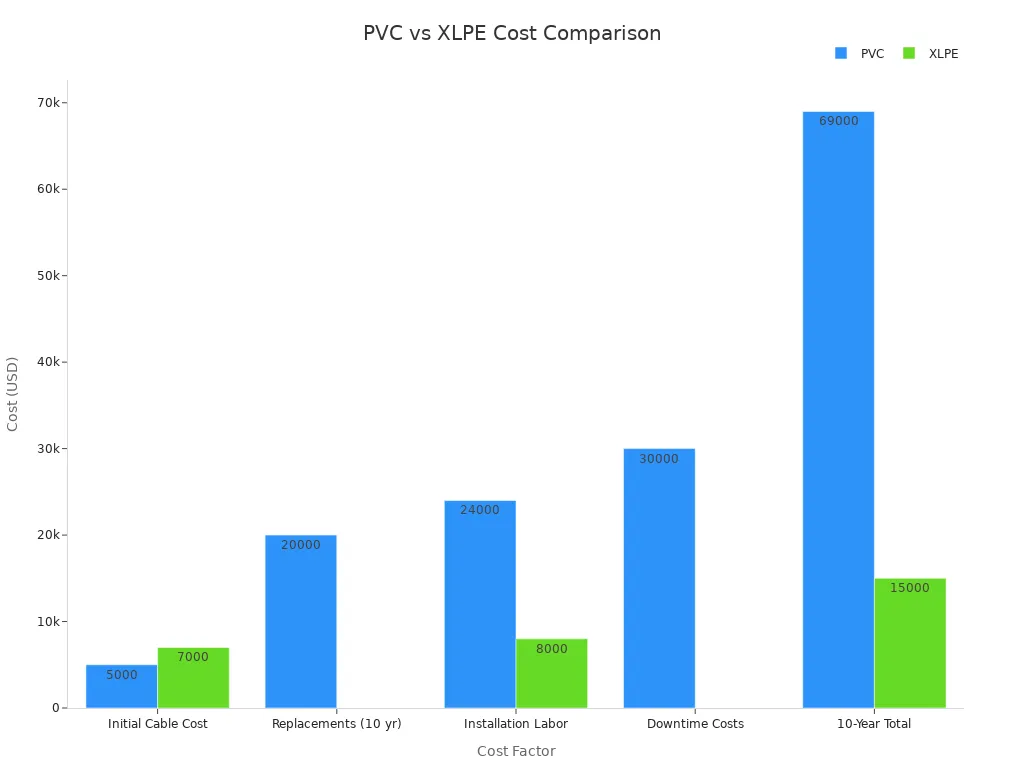
XLPE buys temperature headroom, dielectric performance and slower ageing, at a material cost premium that is recovered only when at least one of heat capacity, space, or replacement access is genuinely constrained. PVC buys lower first cost and easier handling, at the price of a 70 °C ceiling and a material that will stiffen with age.
These material property differences shape every choice that follows. PVC wins on first cost and easy processing. XLPE wins on heat resistance and dielectric behavior. Neither wins overall. The service environment decides which trade-off pays off.
Matching Material to Application
Building Wire, Data, and Communication Cable
PVC works well for low-cost, low-voltage indoor jobs. Building wire, data cable, and communication cable all use it. PVC insulation fits circuits up to 1 kV, and many designs are rated at 600 V. Standard PVC runs at 70°C, and flame-retardant grades reach 90°C. This compound is very flexible, so installers can bend and route it through tight spaces easily. It also stands up well to water, oils, and acids.
Data and communication cable follow the same pattern. Special PVC serves as the outer jacket on network cable, where it provides flame and smoke resistance plus physical strength. Many designs also use PVC insulation inside. One common example is Category 5E PVC data cable.
Cable Type | Application | Use Cases | Performance |
|---|---|---|---|
Category 5E PVC Data Communication Cable | Structured cabling | Voice, high-speed data, video, LAN lines in commercial and residential buildings | Up to 350 MHz; rated CMR |
Power Cable and Specialty Uses
PE and XLPE take on the high-voltage and harsh-environment roles. XLPE carries ratings from 1 kV up to 132 kV and beyond, and some transmission networks reach 500 kV. It runs continuously at 90°C, with short-term peaks up to 250°C. It resists moisture better than PVC, so XLPE suits underground, outdoor, and coastal routes. Service life in extreme conditions reaches 40–60 years.
Typical jobs include substation and transformer distribution, industrial plants, renewable energy links, and direct-burial networks. Armored and screened versions handle mechanical stress and electric-field control. The same logic applies beyond cable. A plastic pipe extrusion line and a pe pipe line follow similar material rules, and polyolefin pipe extrusion rewards the same care. Buyers of plastic pipes weigh heat, moisture, and cost the same way.
Selection starts with the service environment, then stiffness. Indoor, dry, low-voltage work points to PVC. Heat, moisture, or high voltage points to XLPE. The machine and the extrusion settings follow that call.
Extrusion Line Selection and Defect Troubleshooting
Choosing by Conductor, Insulation, and Output
Conductor size, insulation thickness, and target output decide how the line is set up. Conductor size controls pay-off, preheating, tooling, and the line speed you can reach. Insulation thickness controls how much output the extruder needs and how much cooling is required. A supplier cannot suggest the right line without these details.
Screw diameter and crosshead bore must fit the planned conductor range. A 45 mm extruder works for conductors of 0.5–6 mm². A 60–90 mm extruder covers 1.5–50 mm². A 120 mm+ extruder handles large power cables above 50 mm². Running a small conductor on an oversized extruder makes material stay in the barrel longer and raises the risk of heat damage. A 60 mm screw at 25:1 L/D is common for medium insulation lines.
Input parameter | Influence on line selection |
|---|---|
Conductor size | Governs pay-off, preheating, tooling and line speed |
Insulation thickness | Governs extruder output and cooling capacity |
Finished outer diameter | Governs tooling and measuring system |
Speed target | Governs extruder capacity and line layout |
Tolerance requirement | Governs control and inspection setup |
Cooling trough length must match line speed and wall thickness. A good rule of thumb is about 1 meter of trough per 1 mm of wall for every 10 m/min of speed. High-speed fine-wire lines may need pressurized water cooling or air quench.
Jiangsu Handing Cable Machinery Co., Ltd., founded in 2002, builds wire and cable extrusion lines, crossheads, hoppers and dryers, and continuous extrusion machines for both PVC and PE lines. Its 16,000+ m² factory lets buyers set up one machine platform across the full product range. A single-material PVC building wire job needs only a standard single-screw line with a corrosion-resistant barrel. Multi-material work calls for a bimetallic barrel, a high-torque drive, and a modular crosshead.
Common Defects and Where to Look
Surface roughness, eccentricity, and voids each trace back to a specific cause. Roughness and pitting often come from leftover moisture in the PVC dry blend turning into steam. Low melt temperature causes incomplete plasticization. Overheating leaves black specks and streaks. Worn die tooling leaves scratches.
Defect | Most likely cause |
|---|---|
Eccentricity | Die/mandrel misalignment; uneven die-head temperature |
Surface roughness | Moisture, low melt temperature, worn tooling |
Voids | Moisture in material; unstable melt pressure |
Ovality | Weak vacuum; uneven cooling; haul-off misalignment |
Troubleshooting follows the evidence. Calibrate temperature controls often and watch the line at all times. Dry material before the hopper. Center the die and check that pressure stays steady. HANDING's quality inspection team checks each spare part, and its after-sales support helps buyers trace defects to the machine or the process.
Picking the right setup follows a clear order. The service environment and application come first. Next comes the material choice, then the extruder type, screw design, temperature profile, cooling, and line speed. PVC works well for low-voltage indoor cable at low cost. PE and XLPE fit high-voltage, moisture-exposed, or outdoor work. Neither material is better in every case. Each one fits specific cable types and production goals. A balanced extrusion setup matches the polymer to the job. The machine settings follow that choice. HANDING builds wire and cable extrusion lines for both material families. Buyers can contact the team at export@handingmachinery.com for setup advice that fits their real production needs.
FAQ
Which extruder type suits PVC dry blend?
A conical twin-screw extruder works best for PVC dry blend. It mixes at low screw speed and keeps the heat-sensitive compound from scorching. A single-screw machine handles pelletized PE instead. Each setup fits its own polymer.
When should a buyer choose PE or XLPE over PVC?
Heat, moisture, or high voltage points to PE or XLPE. PVC fits dry, low-voltage indoor work. The service environment decides first, then stiffness. The material choice then drives every setting downstream.
How does conductor size guide extrusion line selection?
A 45 mm extruder covers 0.5–6 mm² conductors. A 60–90 mm machine covers 1.5–50 mm². A 120 mm+ extruder handles large power cables above 50 mm². Insulation thickness and target output help narrow the choice.
What causes surface roughness and voids?
Moisture in the dry blend turns into steam and pits the surface. Low melt temperature leaves incomplete fusion. Worn die tooling leaves scratches. Voids come from moisture and unstable melt pressure. Dry the material and center the die.
How do temperature profiles differ between the two materials?
PVC runs at lower barrel temperatures, and operators keep control near ±2°C. PE and XLPE run hotter through barrel and die. Each extrusion line needs its own temperature profile. A mismatch causes burning or a starved melt.