


What to Consider When Choosing Wire Stranding Machine Suppliers
 Aug 31, 2026|
 View:172
Key Takeaways
Look at a supplier's history and certifications to make sure they are reliable.
Compare machine speed, capacity, and energy use to see how efficient they are.
Look for automation features that boost accuracy and cut down on waste.
Pick a supplier who makes machines that fit your specific cable types.
Think about the full cost of owning the machine, not only what you pay to buy it.
Key Qualities of Reliable Wire Stranding Machine Suppliers
You need more than just a machine when picking a partner for your cable production. You need a supplier who supports their equipment for many years. The right partner brings experience, proven quality, and deep technical skills to every project. The wrong partner brings delays, flaws, and frustration. This section helps you tell dependable wire stranding machine suppliers apart from those who only sell hardware.
Assessing Track Record and Industry Certifications
A supplier's past shows how they handle problems. Companies that last for decades in this field have solved real issues for real customers. One such supplier has a long operating history, a large factory, and a dedicated workforce. This long history signals stability. It also shows they have faced market changes and adjusted their products to match.
Certifications add another layer of proof. Outside groups check that a supplier meets certain standards. These credentials are not just for show. They stand for checked processes and steady quality control. The table below lists common certifications to look for when checking suppliers.
Certification | What It Means |
|---|---|
CQC | China Quality Certification, confirming compliance with Chinese safety and quality standards |
CE | Conformité Européenne, marking conformity with EU health, safety, and environmental protection rules |
ISO | International Organization for Standardization, showing adherence to global quality management systems |
SGS | Société Générale de Surveillance, a third-party inspection and verification certification |
These certifications matter because they come from outside the supplier's own claims. A third party has inspected their factory, their processes, and their finished machines. You can trust that check more than a brochure. When you compare suppliers, ask for their certification numbers. Then check those numbers with the issuing groups. This simple step protects your money.
Evaluating Technical Expertise and R&D Capabilities
Cable manufacturing changes all the time. New conductor materials appear. New cable designs enter the market. New efficiency standards raise the bar for production lines. A supplier who cannot innovate will leave you with old equipment. That is why research and development ability matters as much as production history.
Reliable suppliers have mastered independent research and development. Their team does not copy existing designs. They study new needs and build machines to meet them. This ability lets them adjust equipment for different conductor materials like copper and aluminum. It also lets them handle various cable types, from flexible cords to rigid power cables. When you need a machine for a specific job, a supplier with strong R&D can customize the solution.
Ask possible suppliers about their engineering team. How many engineers work in their R&D department? What new ideas have they brought out recently? Do they hold patents for their designs? These questions show whether a supplier leads the industry or follows it. A supplier who invests in research shows commitment to your long-term success. They will help you stay competitive as cable technology grows.
Technical skill also shows in the parts they choose. Reliable suppliers use proven components from global makers. They add PLC control systems for steady operation. They design for energy savings and low noise levels. These details affect your daily production costs and your workers' safety. A machine that runs smoothly for years saves you much more than the first purchase price.
When you check wire stranding machine suppliers, look past the shiny outside. Examine their history, verify their certifications, and dig into their technical depth. These qualities decide whether you gain a partner or just a vendor.
Evaluating Machine Quality and Technology
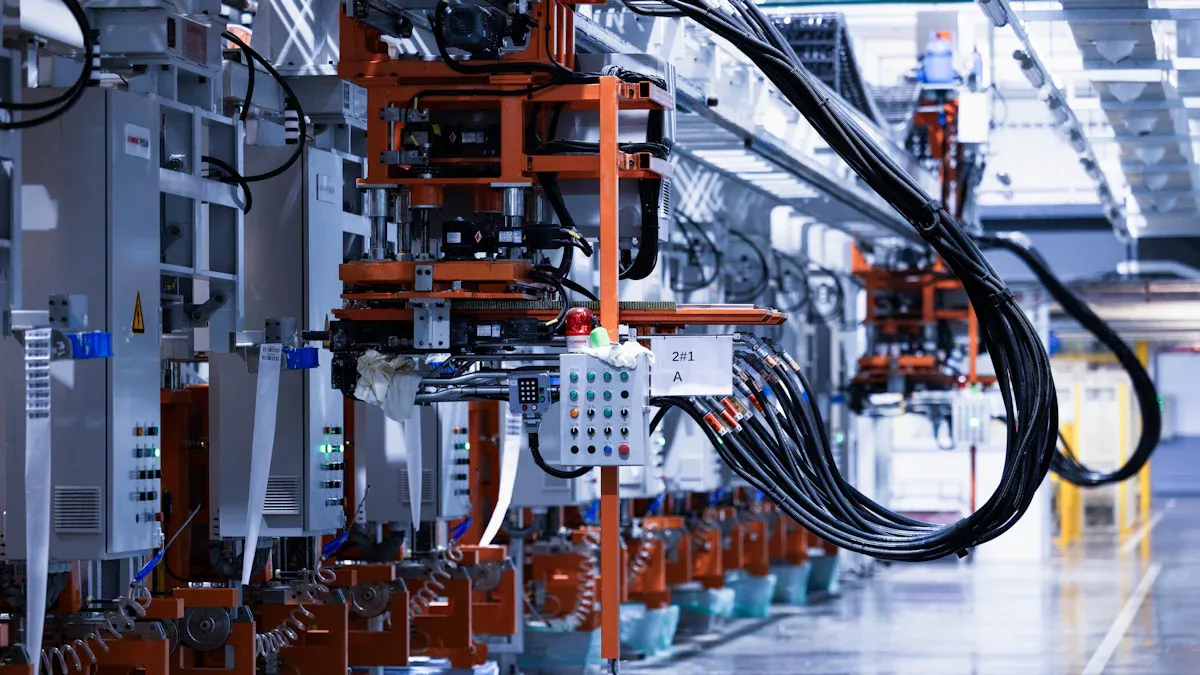
Machine specs determine how fast you can produce cable and how much it costs to run. You need to compare stranding speed, capacity, and energy use across different models. You also need to check automation features that control precision. These factors directly affect your output quality and your bottom line. Reliable wire stranding machine suppliers provide clear data on these specs. They do not hide performance numbers.
Speed, Capacity, and Energy Efficiency
Stranding speed is measured in rotations per minute (RPM). Different machine types deliver different speeds. The table below shows typical RPM ranges for common stranding machines.
Machine Type | Typical Speed (RPM) |
|---|---|
Single-twist bunching | 3,000 – 4,500 |
Double-twist bunching | 2,500 – 3,500 |
Rigid frame stranding | 600 – 1,200 |
Tubular stranding | 1,500 – 2,500 |
A double-twist machine gives you two twists per rotation. That means higher line speed for the same RPM. For example, for a 25 mm lay length, a single-twist strander running at 3,000 RPM yields 75 m/min line speed. A double-twist machine at the same RPM delivers 150 m/min, effectively doubling throughput. Modern double-twist machines can run at 5,500 RPM on fine wire, achieving line speeds above 275 m/min. That is a productivity gain of 85 to 110 percent compared to single-twist machines, depending on bow balance and wire quality.
You also need to consider the machine's capacity, which relates to the spool size it can handle. Larger spools allow longer continuous runs but may reduce maximum RPM. For example, a small machine with a 300-400 mm spool can reach 5,000 to 7,000 RPM, giving line speeds of 350 to 400 m/min. A medium machine with a 500-560 mm spool runs at 3,500 to 4,500 RPM, delivering 250 to 300 m/min. A large machine with a 630-800 mm spool operates at 2,000 to 3,000 RPM, with line speeds of 150 to 200 m/min. You must match the machine size to your typical cable lengths and production volumes.
Energy efficiency is another critical spec. Modern machines can reduce energy usage by up to 30 percent compared to older models. Double twist bunching machines often use energy-efficient motors to lower power consumption. They also occupy about 65 percent of the floor space of a traditional rigid-frame strander. This saves you both energy costs and factory space. Some machines use independent motors and power-on-demand technology, consuming only as much energy as needed for the current load. This flexibility supports diverse product mixes and smaller batch sizes without wasting energy.
Automation, Control Systems, and Precision
Precision in stranding comes from advanced control systems. Programmable logic controllers (PLC) manage the entire process. They use high-resolution encoders and servo motors to ensure accurate speed ratios between the flyer and the capstan. This directly enables precise lay length control. You input the desired pitch value into the human-machine interface (HMI), and the system dynamically adjusts motor speeds to maintain that value. It compensates for minor fluctuations during operation, keeping your cable consistent.
Closed-loop tension adjustment is another key feature. PLC-based systems integrate load cells and tension sensors. They use feedback to automatically adjust motor speeds or braking forces. This maintains constant take-up tension and prevents defects like loose strands or wire breakage. The result is a stable, high-quality product run after run.
Reliable suppliers incorporate PLC control systems and global components in their machines. This combination ensures stable operation and energy efficiency. Their equipment uses proven parts from worldwide suppliers, reducing the risk of breakdowns. The control systems also monitor noise and vibration levels. Lower vibration means longer machine life and better worker safety. You want a machine that runs quietly and smoothly for years.
When you evaluate wire stranding machine suppliers, ask for detailed specs on control systems. Find out if they use high-resolution encoders, servo motors, and closed-loop tension control. These features separate average machines from top-tier equipment. Investing in automation now saves you money on rework and downtime later.
Customization and Support Considerations
Every cable factory runs different products. You might make flexible cords one day and rigid power cables the next. Your stranding machine must handle both jobs without constant changeovers. This is why customization matters more than raw specs. The best wire stranding machine suppliers study your production line before they quote a price. They ask about your conductor materials, your typical lay lengths, and your output targets.
Tailoring Machines to Specific Cable Types
Copper and aluminum behave differently inside a stranding machine. Copper is ductile and forgiving. Aluminum is lighter but more prone to surface damage. A machine set up for copper may scratch aluminum wire or break it during high-speed runs. Your supplier should adjust tension controls, bow angles, and take-up systems for your primary material.
Cable flexibility also changes the machine setup. Flexible cables need smaller lay lengths and gentler handling. Rigid cables allow faster speeds but require stronger capstans. A good supplier builds these adjustments into the machine design, not as afterthoughts. They test your actual wire samples before delivery. This testing prevents surprises on your factory floor.
Reliable suppliers design each line around your specific cable types. Their engineers ask about your conductor sizes, your insulation materials, and your final cable construction. They then configure the stranding head, the tension system, and the take-up unit to match. This approach reduces setup time when you switch products. It also keeps quality consistent across different cable runs.
After-Sales Service and Warranty Terms
A stranding machine runs for decades. You will need support long after the installation week ends. Response time becomes your most important metric. When a machine stops, every idle hour costs you money. You need a supplier who answers quickly and sends help fast.
The table below shows response times from several machinery vendors. Use these numbers as a benchmark when you compare suppliers.
Vendor | Average Response Time | On-time Delivery |
|---|---|---|
Platinum Overseas Trade Inc. | ≤5h | 92.3% |
Bobo Machine Co., Ltd. | ≤4h | 100.0% |
Huizhou Adp Optical Communications Co., Ltd. | ≤1h | 97.6% |
Suzhou Sanao Electronic Equipment Co., Ltd. | ≤3h | 99.3% |
Wenzhou East World Import&Export Co., Ltd. | ≤2h | 99.6% |
Shanghai Qipang Industrial Co., Ltd. | ≤2h | 96.7% |
Look for a supplier who commits to a written response time. Ask about spare parts availability. Some vendors stock critical parts locally. Others make you wait weeks for shipping. The best suppliers provide efficient after-sales service to minimize downtime.
Warranty terms deserve close reading. A typical warranty covers parts and labor for a set period. Some suppliers extend this for critical components. Check what the warranty excludes. Wear parts like bow guides and tension rollers often fall outside coverage. Know these details before you sign.
Comparing Costs Among Wire Stranding Machine Suppliers
The price of a stranding machine is not the whole story. You need to look at the total cost of owning the machine over its lifetime. Costs for maintenance, energy, and spare parts all affect your profits. The best wire stranding machine suppliers help you see these hidden costs before you buy.
Total Cost of Ownership and ROI
A 6-strand machine and a 12-strand machine serve different needs. Their costs differ in ways that matter to your budget. The 6-strand machine has a lower first price. Its maintenance cost stays low over time. You rarely replace parts. Downtime over five years stays small. Operator training needs only basic lessons. The total cost of owning the 6-strand machine over five years is lower.
The 12-strand machine costs more at first. Its maintenance expenses run higher. You replace parts sometimes. Downtime over five years is medium. Operators need advanced training to run it well. The total cost of owning the 12-strand machine over five years is higher.
But the 12-strand machine gives better performance for special jobs. If you make complex cables, the extra cost may be worth it. You must match the machine to your production needs. A machine with lower TCO that cannot make your products is not a good deal. A machine with higher TCO that opens new markets may be worth the cost. Think about your product mix and future plans when you figure out return on investment.
Delivery Lead Times and Installation Services
Custom stranding machines take time to build. You must plan your project around these timelines. A custom order takes 8 to 14 months from order to delivery. This sets the baseline for your project schedule. Supply delays for precision parts add 16 to 28 weeks. These delays push back machine delivery and setup. Meeting EU safety rules adds 4 to 8 weeks. This affects your buying timeline when you choose a new supplier.
Some suppliers provide installation and setup services as part of their offer. This helps your team learn the machine properly from the start. You avoid mistakes that cause downtime later. The value of this support goes beyond the first price. It saves you time and money during the key first weeks of production. You get a machine that runs correctly from day one.
When you compare costs, look at the full picture. Add in maintenance, energy, spare parts, lead times, and installation support. The cheapest machine at first may cost you more in the long run. A supplier who offers full support helps you get a better return on your investment.
Choosing the right partner means checking reputation, technology, customization, support, and total cost. Make a checklist from these points before you sign anything. You are not just buying hardware. You are building a long-term partnership that impacts your production for years.
Look for wire stranding machine suppliers who do well in every area, not just one. A supplier with a strong track record, independent R&D, global components, and reliable support will understand your needs. They help you cut downtime and boost output.
Contact a reputable supplier today with your specific needs. Their team will create a solution that fits your cable types and production goals.
FAQ
How can I verify a supplier's certifications are genuine?
Ask for certification numbers directly. Contact the issuing organizations to confirm validity. Check the supplier's official website for documentation. Request factory audit reports if available. A reputable supplier shares this information openly. A reputable supplier provides full certification documentation upon request, allowing you to verify their ISO and CE credentials independently.
What machine specifications matter most for my production line?
Focus on stranding speed (RPM), wire diameter range, and spool capacity. Compare energy consumption per unit of output. Check noise and vibration levels for worker safety. Confirm the control system supports your required lay length precision. Match these specs to your actual cable types and production volumes before making a decision.
What warranty terms should I expect from reliable suppliers?
Standard warranties cover parts and labor for a set period. Some suppliers extend coverage for critical components. Read exclusions carefully. Wear parts like bow guides and tension rollers often fall outside warranty coverage. Ask about spare parts availability and response times. A reliable supplier commits to prompt technical support and rapid after-sales service.
How do I calculate the true cost of a stranding machine?
Add maintenance, energy consumption, and spare parts costs to the purchase price. Factor in installation and operator training expenses. Consider downtime costs during repairs. Calculate the total cost of ownership over five years. Compare this figure across suppliers. The cheapest machine upfront may cost more over time if it requires frequent maintenance.