


 Oct 23, 2026
 View:13
For cable manufacturers, selecting the right material is only the first step. Producing cables with consistent dimensions and reliable performance also depends on the extrusion equipment, process parameters, and coordination of the entire production line. Jiangsu Handing Cable Machinery Co., Ltd. specializes in the development and manufacturing of wire and cable machinery. This article explores the production requirements of TPU/TPE cables across different applications and explains the role of extrusion equipment in their manufacturing processes.
Planning a TPU/TPE Cable Production Line?
Discuss your cable application, material requirements, and production targets with HanDing to explore a suitable extrusion solution.
Discuss Your ProjectDiverse Applications Across Industrial and Electrical Sectors
TPU cables are commonly used in the following applications, depending on the material formulation, cable construction, and technical specifications:
EV Charging Cables: Used in electric vehicle charging systems, these cables need to withstand frequent handling and outdoor operating conditions.
Robotic Cables: Designed for industrial robots and related equipment, some robotic cables must endure repeated bending and twisting during operation.
Drag Chain Cables: Used in machine tools and automated production lines, these cables are designed to accommodate continuous reciprocating movement within cable carrier systems.
Wind Power Cables: Used in wind turbines and related equipment, these cables may need to withstand torsional stress and low-temperature environments.
Drilling Cables: Used in oil and gas drilling operations, these cables may be exposed to oil, chemicals, and other demanding environmental conditions.
Reeling Cables: Used in cranes, port equipment, and other cable-reeling systems, these cables must withstand repeated winding, unwinding, and pulling forces.
Communication Cables: Certain communication cables use TPU sheaths and require consistent sheath dimensions and good surface quality.
TPE cables are commonly used in electronic wires, power cords, and other products for internal connections and power transmission in electrical and electronic equipment.
Different Applications Require Different Extrusion Processes
Even when TPU or TPE is used, cable structures and production requirements can vary significantly depending on the application. EV charging, drag chain, and robotic cables often involve sheath extrusion, where uniform sheath thickness, proper coverage of the cable core, and a stable outer diameter are important. Fine electronic wires with thin insulation layers place greater emphasis on wall thickness consistency and surface quality. Similarly, communication cables require consistent dimensions and a smooth, uniform sheath surface.
As a key stage in cable manufacturing, extrusion requires careful control of several factors:
Temperature and Plasticization Control: TPU and TPE are sensitive to processing conditions. Stable temperature control and appropriate plasticization are essential for maintaining melt consistency and smooth, continuous extrusion.
Crosshead and Dimensional Control: The selection and configuration of the extrusion crosshead and tooling affect insulation or sheath concentricity, wall thickness uniformity, and outer diameter accuracy.
Cooling and Haul-Off: Cooling conditions must be coordinated with line speed to ensure proper material solidification and minimize deformation and surface defects.
Pay-Off, Take-Up, and Online Inspection: Stable tension control and appropriate online inspection systems help maintain dimensional consistency and monitor production conditions throughout the process.
Cable Extrusion Equipment: A Key Component in Insulation and Sheathing Production
Cable extrusion equipment continuously applies processed polymer material around a conductor or cable core to form the required insulation layer or outer sheath. The compatibility of the equipment configuration with the material properties, cable construction, and production requirements plays an important role in achieving consistent dimensions and surface quality.
Therefore, selecting an extrusion solution for TPU/TPE cables should involve more than simply identifying the material or end-use application. Manufacturers also need to consider the specific material grade, cable specifications, structural design, and target production capacity.
Depending on the cable structure and production requirements, manufacturers may evaluate standard cable extrusion lines, high-speed extrusion lines, or dual-layer co-extrusion lines. The appropriate configuration should be determined by the required cable construction, material processing characteristics, output targets, and other technical parameters.
Explore HanDing Cable Extrusion Equipment
Review available extrusion line configurations for wire and cable insulation and sheathing applications.
Explore Extrusion Lines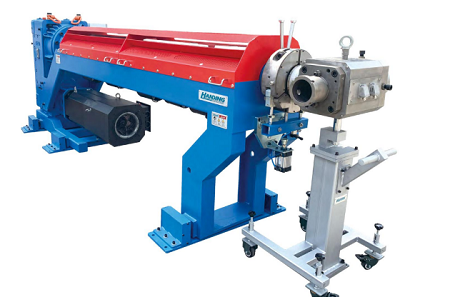
HANDING: Specializing in Wire and Cable Machinery
Founded in May 2002 and located in the Lijia Industrial Zone of Changzhou, China, Jiangsu Handing Cable Machinery Co., Ltd. specializes in the development and manufacturing of wire and cable production equipment. Its product range covers key cable manufacturing processes, including extrusion, bunching and stranding, and cabling.
HanDing's extrusion equipment portfolio includes high-speed extrusion lines, standard extrusion lines, dual-layer co-extrusion lines, low-smoke halogen-free (LSHF) extrusion lines, building wire extrusion lines, and new energy cable extrusion lines. These solutions can support insulation and sheathing applications involving materials such as PVC, PE, LSHF compounds, TPU, and TPE, subject to the specific equipment configuration and processing requirements.
To address the diverse needs of TPU/TPE cable production, HanDing evaluates equipment options and complete production line configurations according to each customer's product requirements, material characteristics, cable construction, and production capacity targets. For cables with specialized performance requirements, the final equipment configuration should be assessed based on the material grade, technical specifications, and actual processing conditions.
Contact HanDing for TPU/TPE Cable Extrusion Solutions
If you are planning to develop or expand your TPU/TPE cable production, contact HanDing to discuss your equipment requirements.
To help identify a suitable extrusion solution, please provide details such as the cable application, material type, conductor or cable core specifications, insulation and sheath structure, and target production capacity. This information will help HanDing evaluate your requirements and discuss an appropriate equipment configuration for your production line.
Looking for a Cable Extrusion Equipment Supplier?
Share your project specifications with HanDing for a more targeted discussion of equipment selection and production line configuration.
Request a QuoteNote: The suitability of an extrusion line for TPU or TPE depends on the specific material grade, cable design, processing conditions, and equipment configuration. Please confirm these requirements with the equipment supplier before finalizing your production line.